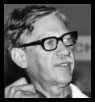
Adrianus Dingeman de Groot, commonly known as Adriaan de Groot, was born on October 26, 1914 in Santpoort, Netherlands. He was a psychologist and chess master, and became famous for conducting cognitive chess experiments in the 40s, 50s and 60s. His initial thesis on the subject, "Het denken van den schaker", was published in 1946. The English translation, Thought and Choice in Chess, appeared in 1965.
De Groot conducted his chess experiments on players from many different backgrounds, all the way from rank beginners to strong grandmasters. His goal was to explain how chess experts could grasp a full board position, assess the situation, find constructive ideas of what to do next, and in fact find good moves, all withing seconds of being confronted with the position.
In his experiments the participants were required to look at a chess position, while expressing their thought processes verbally, while a researcher recorded them. De Groot's most startling result was to show that in grandmasters most of the processes that went into finding a good move occurred during the first few seconds of contemplation of the position. He defined four stages of the thought process:
- The orientation phase – here the strong chess player grasped the position and formulated general ideas of what to do.
- The exploration phase – this was characterised by the analysis of concrete variations.
- The investigation phase – this was where the strong player actually decided on a probable best move.
- The proof phase – here the subject spent time in confirming the validity of the choice reached in phase three.
De Groot drew attention to the role of memory and visual perception in these processes, and to how strong players, especially grandmasters, used experience with past positions to expediate the processes listed above.
Drawing on earlier studies (by Djakow, Petrowski and Rudik in the 20s) de Groot also exposed subjects very briefly, for 3-4 seconds, to positions taken from a game. He found that grandmasters and masters were able to recall the location of 93% of the pieces, while the experts remembered 72% and the class players merely 51%.
In later (1973) studies conducted by Herbert A. Simon and W.G. Chase the experiments were conducted with real game positions and compared with random positions. The Americans discovered that in the real positions the performance of their subjects declined proportionally to their chess ratings, but that in the random position players of all levels did approximately the same. Simon and Chase came to the conclusion that higher-ranked players use a form of chunking, or pattern-matching, that allows them to rapidly encode macro features of the positions.
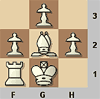 Normal club players easily recognize the fianchettoed bishop on the kingside in a single glance, grasping the six pieces involved as a set or chunk, which rank amateurs will need to memorize each piece and its location separately. Grandmasters know tens of thousands of such chunks and can find relevant patterns in any meaningful game position. Further analysis, conducted by de Groot, suggested that they recognised the functional relationships between the pieces, rather than the actual positions and spatial relationships. For instance a chunk of pieces in which a bishop pinned a knight against the queen would be remembered as a pin rather than by the actual positions of the bishop, knight and queen on the board.
On a personal note
In the 80s I did a series of TV documentaries for national German television on computer chess and the cognitive processes involved in human chess processing. Naturally we drew heavily on the works of Adriaan de Groot, and of Simon and Chase, and other researchers. In particular we measured the accuracy with which amateurs and grandmasters were able to reproduce a position they had been exposed to for 3-5 seconds; the ability of both groups to come up with a meaningful continuation; and the way their eyes moved while processing the position. But this is the subject for another article.

Eye movement experiments with GMs (here Andras Adorjan and Helmut Pfleger)
Because of the importance of his work to the computer chess community, de Groot was the Honoured Guest of the International Computer Chess Association during the 1986 World Computer Chess Championship in Cologne, which I helped to stage. It is from this event that I find the only picture I have of the Dutch researcher.

Frederic Friedel with Adriaan de Groot in Cologne 1986
At 71 Adriaan de Groot was lively, engaging and also quite humorous in the discussions we had. I kept him briefed on the experiments we had conducted in our TV documentaries and on recent developments in computer chess. He was deeply interested in the subject, and especially in the consequences for the philosophical definition of computer intelligence. Many of the opinions which I hold today in this area were first vented in our discussions in Cologne. I did not meet him often after that, but we corresponded for a while and he "lent" me a number of books on the subjects we had discussed (later he told me I could keep them). I thank Adriaan for all the wonderful ideas he implanted into my mind.